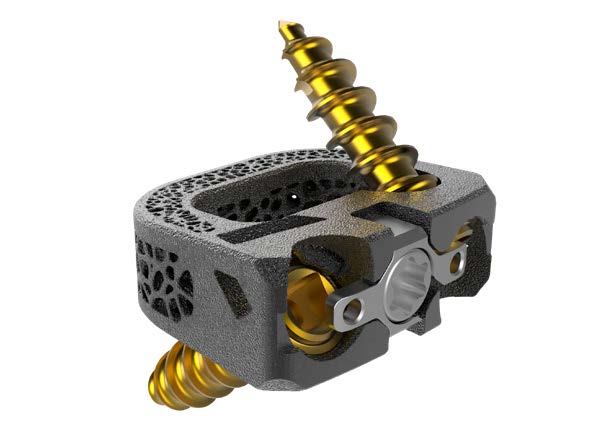
Innosys (CEO Ju Mi Chung), a research and manufacturing specialist in orthopedic implants, announced on the 17th that its 3D printing-applied cervical surgical cage ‘UniSpace Stand-Alone C Cage (hereinafter UniSpace)’ has obtained 510k approval from the US Food and Drug Administration (FDA). 510k is a system by which the FDA verifies the safety and efficacy of medical devices.
UniSpace is a structure inserted in place of the removed damaged disc during spinal fusion surgery, which is performed to fuse the upper and lower vertebrae for the treatment of degenerative cervical spine disorders. It is designed to replace the height and angle of the disc. It is commonly used for the treatment of what we often refer to as neck disc damage.
Through the FDA approval of UniSpace, Innosys has been recognized for its safety and effectiveness. By offering differentiated structures and size options compared to existing products, the company is expected to accelerate the expansion of its portfolio within the US medical device market and its entry into the global market.
The structure of UniSpace has been developed as an independent (stand-alone) design, with the cage that replaces the damaged disc and the screw (fixation screw) that secures it integrated into a single unit. This eliminates the need to insert a separate cervical plate after cage insertion, providing high user convenience. From the patient’s perspective, shorter surgery time and minimized incision sites can be expected to lead to faster recovery after surgery.
UniSpace has further enhanced safety by applying a dual-locking structure to prevent the screw from loosening inside the body. The ‘automatic locking device using an elastic band,’ currently under patent application, automatically locks the screws connected to the upper and lower bones as the primary locking mechanism. Subsequently, attaching a locking plate to the back of the cage further enhances the fixation strength of the screws.
Moreover, by applying 3D printing technology to biocompatible titanium material, a porous structure similar to human cancellous bone is realized, promoting rapid bone fusion in patients after surgery. 3D printing technology allows for relatively free product design, enabling fine-tuning of the cage’s width, area, height, and angle. Currently, UniSpace can be printed in 107 sizes, allowing for selecting the optimal cage size for each patient. The optimized size for patient treatment can be proposed based on factors such as gender and skeletal size, which is expected to result in more favorable surgical outcomes compared to conventional machined products.
Furthermore, UniSpace is designed to enhance strength by up to 2.66 times compared to existing products while preventing the hard titanium from digging into normal bones, ensuring patient safety.
In the United States, fusion surgery using cage insertion is more common than artificial disc insertion for the treatment of degenerative disc disorders. Artificial disc insertion is projected to account for only about 14% compared to fusion surgery by 2026, making cervical cages a highly promising growth prospect.
Ju Mi Chung, CEO of Innosys, stated, “UniSpace is a product designed in collaboration with local doctors from the development stage to provide optimized treatment. By utilizing 3D printing technology, we have achieved a low-density structure optimized for bone fusion and implemented an automatic screw locking mechanism, enabling faster and more effective treatment outcomes for patients. The US approval allows us to receive preferential benefits when entering global markets, not only in North America but also in Central and South America, Oceania, and beyond, expanding our export opportunities to more countries.”
Innosys plans to begin supplying UniSpace to Korea, the United States and Chile starting from August this year. Additionally, the company is preparing for market expansion in Central and South American regions such as Brazil, Mexico and Colombia, as well as Asian countries like Vietnam and Indonesia.